

AI Opens New Frontiers for Chemistry and Interdisciplinary Research — Future Chemistry Forum

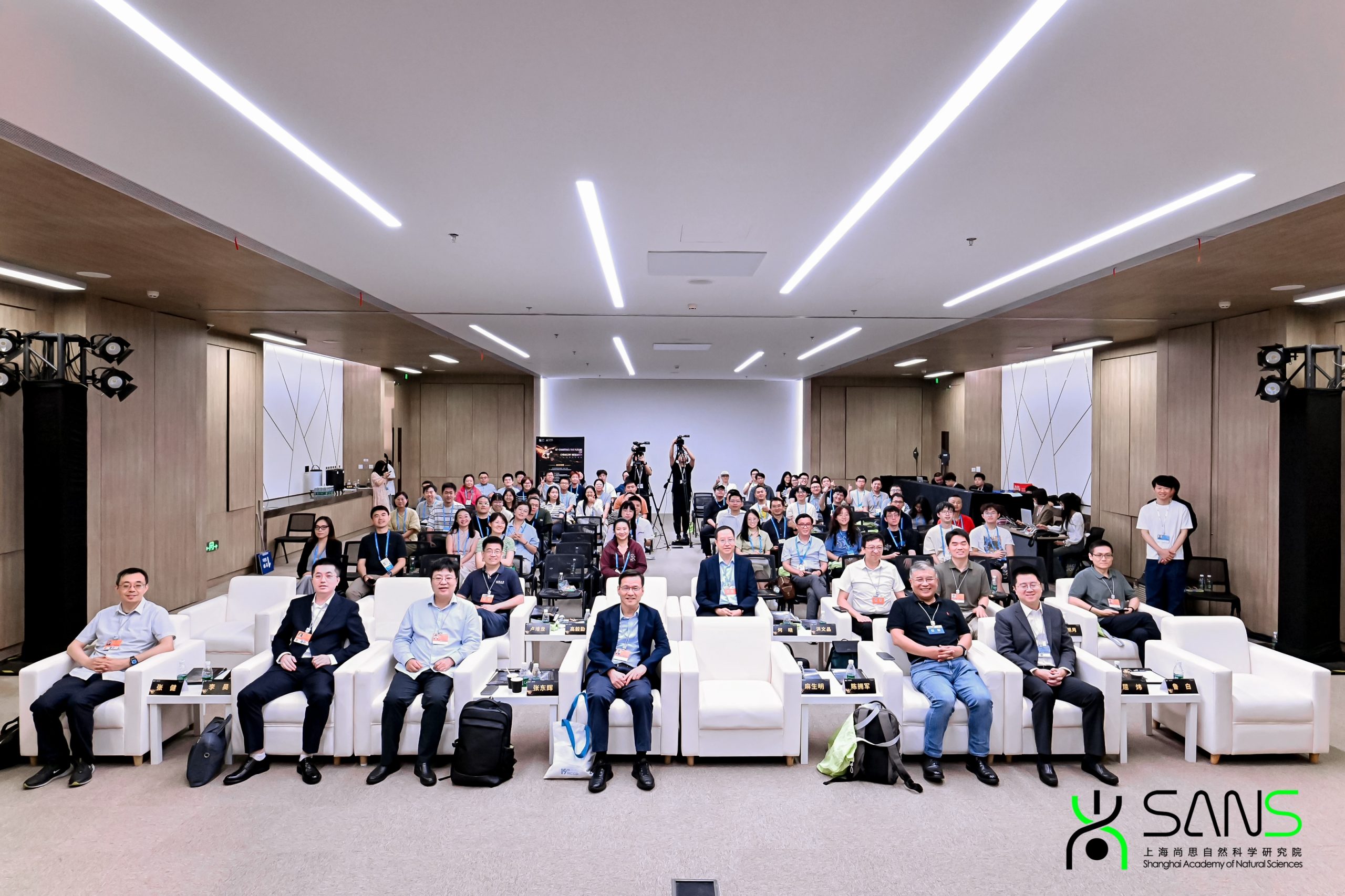
As artificial intelligence (AI) advances at an unprecedented pace, its influence on chemistry and related interdisciplinary fields brings not only extraordinary opportunities but also new challenges. To explore the future directions of chemistry in the AI era, the Shanghai Academy of Natural Sciences (SANS) hosted the Future Chemistry Forum on September 22. The event brought together leading scientists from China and abroad, along with emerging young researchers, to discuss how AI is reshaping the paradigms of chemical research today and in the years ahead.
Amid the long-standing “exponential wall”—the explosive complexity of molecular systems that limits traditional chemistry—AI is rapidly becoming a key engine for breakthroughs. This forum provided a unique vantage point to examine this transformation.
Professor Xueming Yang of the Dalian Institute of Chemical Physics, Chinese Academy of Sciences (CAS), highlighted three pillars that support the development of chemistry as a discipline: experimental technologies/instruments, theoretical methods/models, and now AI as the third driving force. AI’s core value, he noted, lies in its ability to enhance scientific predictability, accelerating progress in materials discovery, drug development, and other critical problems. He also cautioned against falling into the trap of “AI for AI,” stressing that meaningful AI applications must remain grounded in important scientific questions.

Professor Xueming Yang
Scholars
With the theme “AI—Charting the Future of Chemistry Research,” the forum emphasized both the practical implications of using AI to map new scientific frontiers and the strategic significance of shaping future trajectories. Discussions unfolded around three central topics:
- Paradigm Innovation in the AI Era:
How AI can overcome the constraints of experience-driven trial-and-error and restructure research logic. - Development of Intelligent Chemical Systems:
How core algorithms and technical platforms can accelerate the translation of theory into real-world applications. - Interdisciplinary Integration:
How AI may unlock new possibilities across materials science, drug discovery, and other fields.
These themes align with the global trend of AI-driven scientific innovation and point directly to the key pathways toward intelligent chemistry. The forum’s 12-speaker lineup embodied the Pujiang Innovation Forum’s commitment to professionalism, internationalization, and youth. Senior scholars—such as Professors Donghui Zhang (CAS DICP) and Shengming Ma (Fudan University)—joined forces with rising international researchers like Professor Hao Li from Tohoku University, creating a cross-border, cross-disciplinary, and cross-generational exchange of ideas. This intellectual synergy echoed both the Forum’s mission and SANS’s commitment to advancing frontier scientific innovation.
Across the presentations, researchers showcased breakthroughs in precision modeling, generalized methodologies, and data-driven systems. The team of Professor Donghui Zhang has long pursued high-accuracy force fields. Since their development of the FI-NN model in 2013, they have used 10,000 CPU cores running for 400 days to generate over 4 million data points on water potential energy surfaces—achieving order-of-magnitude improvements in accuracy. Incorporating quantum effects, their calculated water density now aligns closely with experimental measurements. Future efforts will extend to ethanol and physiological saline, though achieving such accuracy demands solving astronomical computational challenges.
While Zhang’s team represents “precision depth,” Professor Zhipan Liu (Fudan University) is pioneering a more “efficient and generalizable” approach. His universal global potential model—built atop the LASP platform—can generate a molecule’s 3D structure within 10–20 seconds based solely on its formula, helping chemists avoid ineffective synthesis paths. Looking further ahead, Liu envisions bypassing potential functions entirely to directly design materials and reactions.
Data is the critical gear that enables “emergence,” complementing algorithms and compute power. Professor Hao Li (Tohoku University) introduced the concept of “digital materials,” leveraging large-scale databases, AI models, and automated experimentation to build a closed loop of prediction—validation—feedback, accelerating the shift from experience-driven to data- and intelligence-driven chemistry.
New experimental strategies are also emerging as AI integrates with laboratory workflows. Professor Shengming Ma (Fudan University) described moving from traditional “shaking flasks” to “mining data.” Using just 476 data points, his model achieved an R² of 0.6; after adding descriptors and optimizing weights, further improvements are expected.
Some scholars pushed further into the frontier of embodied intelligence and the challenge of AI hallucinations. Professor Xiao He (East China Normal University) presented ChemGPT 2.0 and an embodied robotic system for AI-accelerated atmospheric chemistry mechanism analysis. Professor Wenjing Hong (Xiamen University) shared breakthroughs in supramolecular radical electronics, demonstrating high-conductivity and low-energy molecular devices with implications for green chemistry and molecular electronics.
However, Professor Jian Jiang (CAS Institute of Chemistry) cautioned against purely data-driven approaches:
“AI hallucinations are difficult to eliminate; relying solely on data-driven models for experiments may create safety risks. Physics-informed AI models are essential for AI for Chemistry.”
AI’s momentum is even more pronounced when chemistry meets other disciplines. In drug discovery, Professor Jian Zhang (Shanghai Jiao Tong University) presented first-in-class drug design efforts focusing on allosteric modulators, including P53-related compounds already advancing into clinical stages. Dr. Mingyue Zheng (Shanghai Institute of Materia Medica, CAS) highlighted pipelines for AI-enabled target prediction, deconvolution, and new target identification.
In protein engineering, Professor Liang Hong (Shanghai Jiao Tong University) integrated 15 billion protein sequences (including 6.5 billion annotated with extreme environmental labels) into a natural language model capturing the “grammar” of amino acids. This reduces experimental workload to 20–30 tests, allowing even non-experts to achieve precise innovations—showcasing AI’s evolution from tool to assistant to driver.
In the life-science frontier, Professor Peilong Lu (Westlake University) presented de novo design of functional membrane proteins, including engineered voltage-gated anion channels capable of modulating neuronal activity. Professor Yiqin Gao (Peking University) discussed multi-agent AI frameworks integrating molecular simulations and 3D chromatin structural studies to advance cancer target discovery.
These innovations signal a fundamental shift: from trial-and-error to predictive research, from isolated laboratories to global data-driven collaboration, and from experience accumulation to algorithmic evolution. As experts noted, AI is not replacing chemists—it is liberating them from repetitive labor, enabling deeper creative inquiry.

Professor Bai Lu
Shanghai has established comprehensive support systems—from computational infrastructure to open-source ecosystems—that empower the integration of AI and chemistry. Emerging research institutions are gaining traction, and SANS, the organizer of this forum, exemplifies this momentum.
Professor Bai Lu, President of SANS, noted that China still faces gaps in original scientific innovation, with research often trapped in “resource-intensive,” “trend-chasing,” or “me too/me better” patterns. SANS advocates that high-quality science must embody four characteristics: frontier-shaping, pioneering, groundbreaking, and disruptive.
From early conception to final execution, the forum showcased Shanghai’s ambitions in the new wave of scientific revolution: frontier scientists gathering on the Bund, transformative lab discoveries integrating with industry, and a city quickly rising as a global benchmark for AI-empowered chemistry and interdisciplinary research.
Multiple media outlets also covered the forum.