

Interdisciplinary—En Route to Future Science
A Recap of the Future Interdisciplinary Research Forum at the Pujiang Innovation Forum
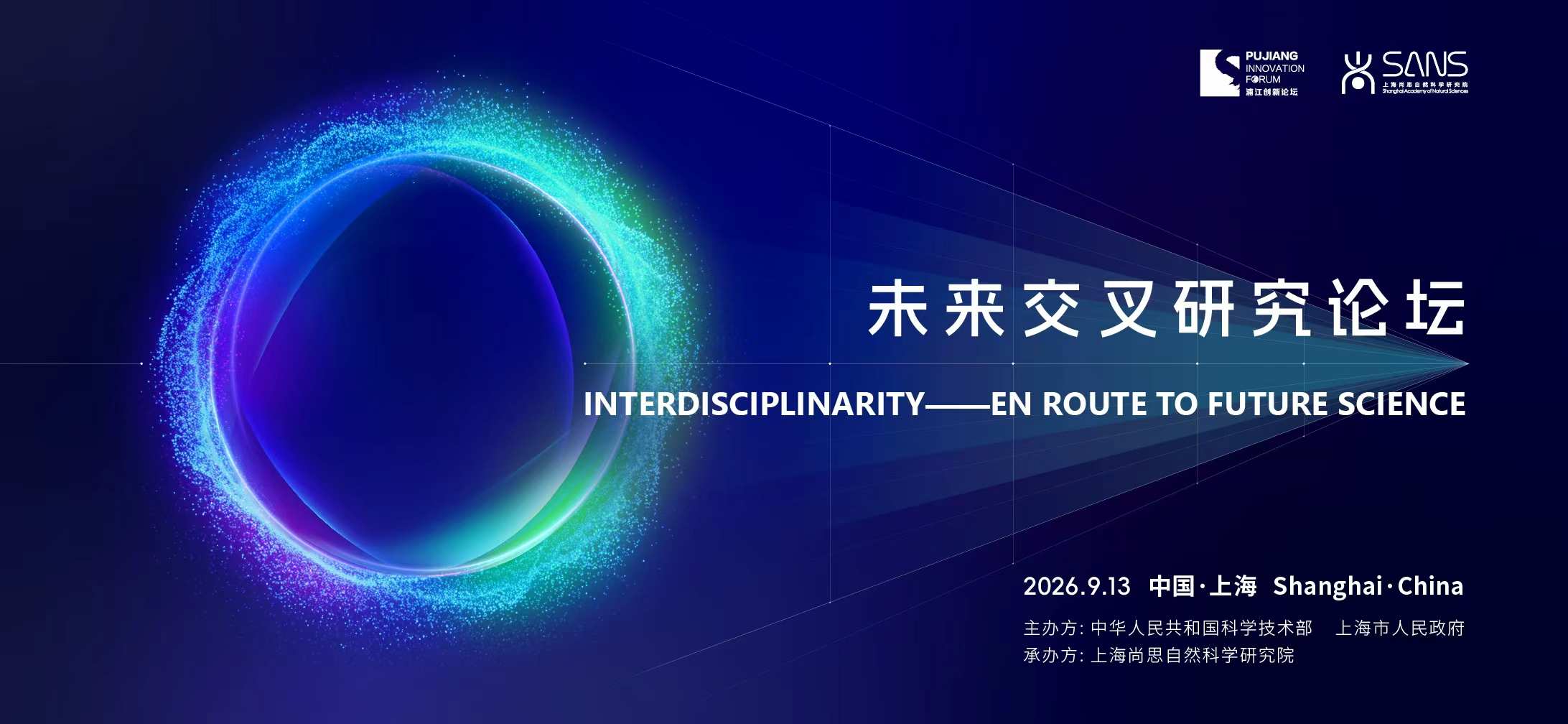
At the frontiers of science today, solutions to many persistent bottlenecks – from understanding how proteins switch on and off to cryopreserving a beating heart – increasingly come from tools developed in other disciplines.
This is the focus of the 2026 Pujiang Innovation Forum’s Future Interdisciplinary Research Forum, themed “Interdisciplinarity – En Route to Future Science”: how interdisciplinarity is moving from an aspiration to a necessity for scientific progress.
Why Interdisciplinarity Has Become a Shared Conviction
Specialization was once seen as science’s highest virtue. Disciplines became increasingly specialized, boundaries between them grew more pronounced, and researchers worked within ever more clearly defined fields. Over the past two decades, however, the paradigm has begun to shift.
The hardest questions – how life works, how the brain thinks, and how materials self-assemble – concern complex systems that span multiple scales and levels. No single discipline can address them alone. At the same time, advances in tools and computing have lowered the cost of crossing boundaries. AI for Science is connecting chemistry, physics and biology, while near-infrared light, quantum probes and electron microscopy are giving the life sciences new ways to sense and measure. In Shanghai and beyond, interdisciplinarity is also being built into research policy through pilot zones for basic research and cross-institutional centers.
Interdisciplinarity is therefore no longer a niche experiment, but a broad scientific consensus. Its value lies in applying the tools and questions of one field to problems another cannot unlock. This can generate original, even disruptive, discoveries; bring basic research closer to practical use; and foster a culture that rewards bold questions and accepts failure.
Chemistry Across Boundaries A New Language for Life Sciences
For the second time, the Shanghai Academy of Natural Sciences (SANS) hosted a sub-forum of the Pujiang Innovation Forum, presenting the rise of interdisciplinary research through a distinctly SANS lens. Chunying Chen opened the program with “The Evolution and Prospect of Nano Driving Scientific Revolution.” The talk set the frame for the day: nanoscience’s expansion from fundamental discovery into health, materials and energy is itself a history of dissolving disciplinary boundaries – and a clear example of how interdisciplinarity drives change.
Along this path, chemistry moves reactions from the test tube into living systems, creating a new syntax for programming life. In “Live-Cell Chemistry and Life & Health,” Peking University’s Peng Chen showed how chemistry can precisely switch proteins on and off in living organisms. Yan Qiao of the Institute of Chemistry, Chinese Academy of Sciences, asked whether life’s smallest functional units could be reconstructed in “Construction and Application of Artificial Cells.” In “Microbial Engineering and Functional Regulation from a Chemical Perspective,” Shanghai Jiao Tong University’s Jinyao Liu examined how chemistry can reshape microbial behavior. Together, the three talks traced a spectrum of rewriting life in the language of chemistry.
Scholars
Physics Goes Deeper Solving What Cannot Be Seen Stored or Measured
The measurement and control capabilities of physics are reaching ever deeper into the microscopic processes of life. Fudan University’s Fan Zhang used penetrating near-infrared light to reveal biological activity in “Near-Infrared Optical Visualization of Living Systems.” In “Application of Quantum Sensing in Life Sciences,” Fazhan Shi of the University of Science and Technology of China brought highly precise quantum measurement into the microscopic world of biology. ShanghaiTech University’s Zhujun Wang used electron microscopy to approach atomic-scale structures in “Electron Microscopy Imaging Techniques for Biological Specimens.” In “Understanding Biological Condensates from the Perspective of Physical Microenvironments,” Westlake University’s Xin Zhang introduced quantitative measures such as micropolarity and microviscosity. Jianjun Wang of the Technical Institute of Physics and Chemistry, Chinese Academy of Sciences, addressed the spatial and temporal constraints of transplantation in “Controlled Cryopreservation of Organs with Viability and Fidelity Preservation.” The tools of physics are becoming new senses for the life sciences.
Scholars
Engineering Does Not End with a Paper
Between understanding a discovery and putting it to use lies the challenge of engineering. In “Innovative Formulation Engineering for Clinical Translation,” Wei Wei of the Institute of Process Engineering, Chinese Academy of Sciences, showed how formulation engineering can bridge fundamental discoveries and clinical application. Xiaodong Chen of Nanyang Technological University, Singapore, explored how flexible electronics can integrate with living tissue in “Bioelectronics: An Endless Frontier across Disciplines.” This was where the forum’s narrative arrived: science ultimately returns to people.
Scholars
Why SANS Builds the Full Spectrum of Interdisciplinary Research
SANS currently focuses on two areas: life sciences, and chemistry and interdisciplinary fields. This choice is deliberate. Chemistry has long been the central science connecting matter and life, and its encounters with other fields can produce the most unexpected breakthroughs. Across this forum – from live-cell chemistry and artificial cells to microbial engineering and organ cryopreservation – chemistry provided a common language. SANS seeks to turn this interdisciplinary potential into a sustained source of innovation in Shanghai.
“The more complex the system, the more it requires interdisciplinary research,” said Forum Chair Xueming Yang. His observation captures the forum’s central idea. SANS does not aim merely to fund individuals or papers. It seeks to cultivate a research culture that supports bold thinking, ambitious sciences, and deep inquiry – giving those willing to cross boundaries the confidence to open new doors. The forum was a public expression of that commitment.
Within the light cone lies the realm of causal connection; beyond it lies the inaccessible. Only by using interdisciplinarity to break fixed constraints can science expand the space of possibility through diversity.